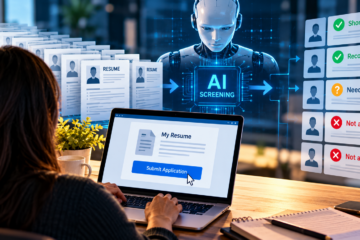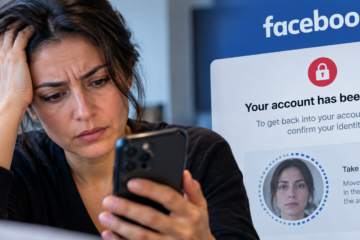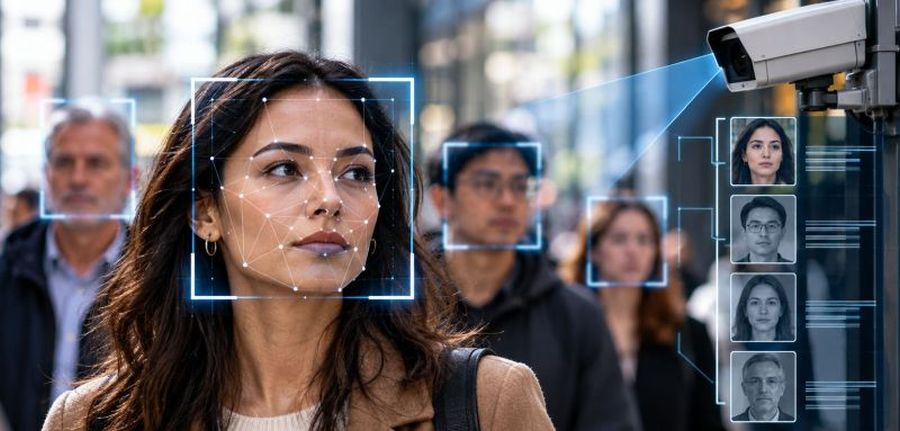
From unlocking smartphones to verifying Uber drivers and identifying strangers in public, facial recognition is transforming security—and raising fundamental questions about privacy and consent.
Your face has always been part of your identity. It allows friends to recognize you, strangers to remember you, and photographs to preserve your likeness. But in the age of artificial intelligence, your face has acquired another function: It can become a digital credential, a security key, and potentially an instrument of surveillance.
Millions of people encounter facial recognition technology without giving it much thought. They unlock smartphones, verify their identities for online services, pass through airport security checkpoints, or submit video selfies to recover digital accounts.
What makes these applications possible is a combination of cameras, mathematical analysis, and artificial intelligence capable of comparing facial characteristics with remarkable speed. Yet behind this convenience lies a troubling question: Who controls the digital representation of your face, and what happens when it falls into the wrong hands?
How Does Facial Recognition Work?
Facial recognition is a biometric technology that uses distinctive physical characteristics to verify or identify individuals. A camera first captures an image or video containing a face. Artificial intelligence software detects the face, analyzes its features, and converts the information into a mathematical representation commonly called a facial template or embedding. That representation can then be compared with another previously recorded image. The process generally serves two different purposes.
Facial verification answers the question, “Is this person who they claim to be?” It typically compares a live image with a single reference, such as a passport photograph or an account holder’s registered image.
Facial identification asks a different question: “Who is this person?” The system may compare an unknown face against thousands or millions of stored records.
The distinction is crucial. Verifying someone’s identity with their participation is fundamentally different from identifying a stranger through a surveillance camera without their knowledge.
Is It Like a Fingerprint?
In important respects, yes. Fingerprints and facial characteristics are both forms of biometric information. They are based on physical traits that can be used to distinguish individuals. But the technologies differ in a particularly significant way.
Traditional fingerprint collection usually requires someone to place a finger on a scanner or otherwise provide an impression. Facial images, by contrast, can be captured from a distance by ordinary cameras. A person walking through a shopping mall, attending a demonstration, or entering a building may be photographed without realizing that software could later attempt to identify them. Both technologies can make mistakes, and neither guarantees identity with absolute certainty.
There is also a more fundamental problem: Unlike a password, a person’s face cannot simply be replaced after a security breach.
Where Is Your Face Stored?
One of the most common misconceptions about facial recognition is that every scan automatically enters a massive central database. That is not necessarily true. Some systems store biometric information locally. Apple’s Face ID, for example, keeps the mathematical representation of the user’s face encrypted within the device’s Secure Enclave. According to Apple, this information does not leave the device or get uploaded to iCloud. Other services use cloud-based systems or specialized identity-verification companies. Depending on the provider, images or biometric templates may be transmitted to servers, compared with reference records, and retained for varying periods.
In large identification systems, databases can contain facial images or mathematical templates associated with names, identification documents, account information, or other personal records.
The privacy implications depend on what is collected, where it is stored, who can access it, how long it is retained, and whether it can be reused for purposes unrelated to the original verification. A company that requests a selfie to confirm an account should not automatically be assumed to have permission to use that image for advertising, surveillance, or training unrelated AI systems.
From Uber to Social Media: Who Uses It?
Facial recognition has spread across industries. Uber uses selfie-based identity checks for drivers and delivery workers. At various times, drivers are asked to photograph themselves to confirm that the person using an account matches its registered profile.
The company also offers identity verification for riders. Depending on the circumstances, the process may involve comparing a selfie with a government-issued identification document through a third-party verification service. Such systems can help prevent impersonation and unauthorized account sharing. But they also create practical problems when verification fails. For a driver whose income depends on access to the platform, an incorrect rejection can have immediate financial consequences.
Social media companies also use facial analysis in certain security and account-recovery processes. Meta, for example, has introduced video-selfie verification methods for some users attempting to regain access to accounts. A facial check, however, does not necessarily resolve every authentication problem. A platform may still require confirmation through a previously recognized device or another security procedure.
Beyond online platforms, facial recognition appears in smartphone security, banking identity checks, airport passenger processing, building access systems, and some retail security operations. These applications should not be treated as interchangeable. A phone verifying its owner locally presents different privacy risks from a retailer attempting to identify every person entering a store.
Can Someone Recognize Your Face Without Your Knowledge?
Technically, yes. A camera does not need to announce that it is capturing an image, and facial recognition software can analyze photographs or recorded video without requiring the subject to pose for a scan.
Some systems can compare images from security cameras with databases containing previously collected photographs. Others can search publicly available images for possible matches.
Whether such practices are lawful depends on the jurisdiction, the organization conducting the identification, the purpose, and the applicable privacy rules. The possibility of identification without consent is one of the most controversial aspects of the technology.
It raises questions that extend beyond commercial privacy. If individuals can be identified and tracked across public spaces, their freedom to assemble, protest, worship, or simply move anonymously may be affected. Facial recognition can become a powerful security instrument. It can also become an instrument of social control.
When Facial Recognition Gets It Wrong
Artificial intelligence does not eliminate the possibility of mistaken identity. Facial recognition systems produce similarity scores and estimates rather than infallible judgments. Their accuracy depends on image quality, lighting, camera angles, database composition, and the technology being used.
Errors can have serious consequences when organizations treat an automated match as proof. A particularly revealing case involved the American pharmacy chain Rite Aid.
The Federal Trade Commission alleged that Rite Aid deployed facial recognition systems in hundreds of stores between 2012 and 2020 without adequate safeguards. According to the agency, innocent customers were sometimes incorrectly identified as suspected shoplifters, confronted by employees, or subjected to embarrassing treatment.
In 2024, a federal court order prohibited Rite Aid from using facial recognition for surveillance purposes for five years. The case demonstrated that the central danger is not merely that an algorithm may be wrong. It is that people and institutions may act on its conclusions without sufficient independent verification.
What Laws Protect Your Face?
The United States does not have a single comprehensive federal law governing every commercial use of facial recognition. Instead, protections come from a patchwork of state privacy statutes, biometric laws, consumer protection rules, and restrictions on government surveillance.
Illinois has one of the country’s most influential biometric privacy laws, the Biometric Information Privacy Act, commonly known as BIPA. It requires covered private organizations to provide notice, obtain written consent before collecting certain biometric identifiers, and establish rules for retaining and destroying the information. The law also permits individuals to bring certain lawsuits for violations.
Texas has a biometric privacy statute addressing the capture and commercial use of biometric identifiers, including records of facial geometry. It imposes consent, disclosure, and retention requirements, with enforcement by the state attorney general.
Washington has legislation governing commercial biometric identifiers, along with separate restrictions and accountability requirements for certain government uses of facial recognition.
Colorado has expanded its privacy protections to address biometric data, including requirements concerning retention policies, security, and consumer rights.
California’s Consumer Privacy Act, as amended, treats qualifying biometric information as sensitive personal information and provides applicable privacy rights and restrictions.
Other states have adopted rules governing police use of facial recognition, sometimes requiring judicial authorization, limiting surveillance, or restricting particular technologies.
The European Union has adopted a different regulatory approach through its AI Act. Among other provisions, it restricts real-time remote biometric identification by law enforcement in publicly accessible spaces, subject to narrowly defined exceptions and safeguards.
These laws do not amount to a universal prohibition on facial recognition. Their scope varies substantially, and a practice permitted in one jurisdiction may be restricted in another.
The Privacy Problem Nobody Can Ignore
The most troubling aspect of facial recognition may be the permanence of the information it uses. A stolen credit card can be canceled. A compromised password can be changed. A face cannot. Although biometric templates are not identical to ordinary photographs and cannot necessarily be converted back into an exact image, they may still be sensitive identifiers. If exposed or improperly shared, they can create lasting privacy and security risks.
Another concern is what privacy researchers call function creep: information collected for one legitimate purpose gradually being used for others. A selfie submitted to recover an account might originally be intended only for identity verification. But without adequate legal and technical restrictions, biometric information could potentially be retained, combined with other databases, or repurposed beyond what the individual expected.
The growing availability of powerful AI systems also raises concerns about impersonation, deepfakes, and attempts to defeat biometric security. Facial recognition may protect an account against unauthorized access, but it should not be the only defense. Strong authentication increasingly requires additional safeguards, including device-based credentials and secure recovery procedures.
How Can Consumers Protect Themselves?
Consumers cannot completely control the use of facial recognition, particularly in public spaces. Nevertheless, several precautions can reduce unnecessary exposure. Before submitting a selfie or identity document, users should determine why the information is required, whether biometric analysis is involved, and how long the company retains the data.
They should review privacy policies for information about third-party verification providers and whether biometric records can be shared or used for additional purposes. Whenever practical, consumers can choose services that offer alternative verification methods, such as passkeys, security keys, or other forms of multifactor authentication.
For smartphones, locally stored biometric authentication can offer meaningful security advantages over systems that unnecessarily transmit sensitive biometric information to remote servers. Users should also examine available account settings, request deletion of biometric information when applicable, and exercise